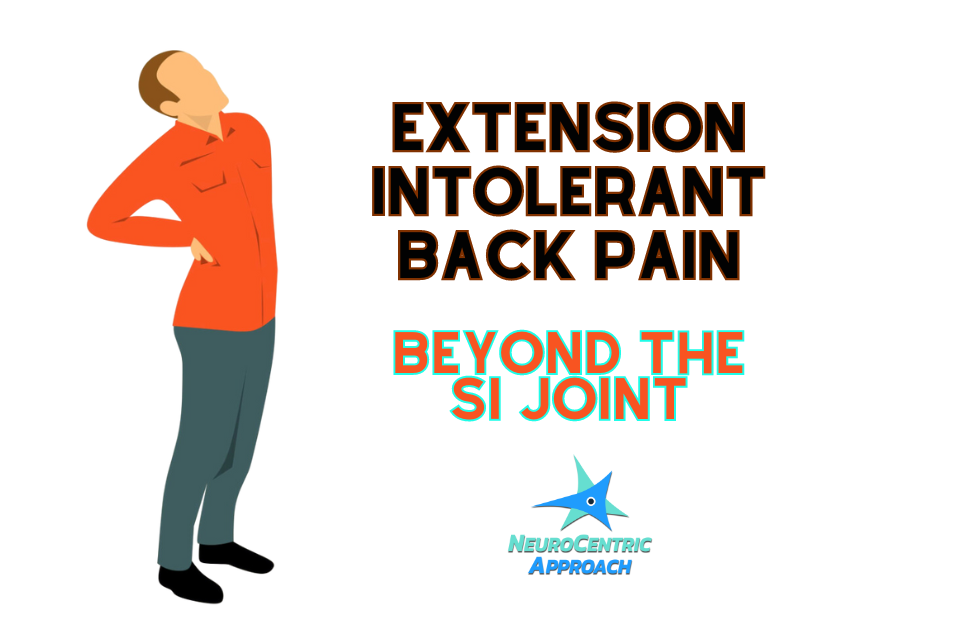
NeuroCentric Approach-Extension Intolerant Back Pain…Beyond the SI
May 18, 2024
NeuroCentric Approach-Case Report-Abdominal Nerve Impingement Causing Unusual Anterior Thigh and Groin Pain-by guest author, Marc Heller, DC
November 16, 2024
NeuroCentric Approach-ITB Syndrome and Crossover Gait
Transcripts from the video above are below...
Members of the NeuroCentric Approach Online Academy meet regularly on Zoom for an informal, online coffee chat and case study.
Below you can find transcripts of this meeting and watch the video from YouTube if desired. To learn more about becoming a member, click below.
Phillip Snell
Okay, take two. Let's see if we can get things started a little better here and there. Now we've got some proper visual going on here.
Okie doke. So I mentioned before a little commerce time, neuro centric approach. The online academy are the, is the area where I have uploaded continuing education courses, recorded continuing education courses, that's me over a slide deck talking about regionally specific applications for the neuro centric approach. And all of that is, all of that material is PACE accredited continuing education at
for chiropractors in states that allow PACE accreditation, the perks for the neuro centric approach online academy. If you are member there, you get discounts on our in-person courses.
And our next in-person course is going to be in St. Louis, Missouri or Missouri depending on where you are in the world. And that is going to be in mid-July.
And then we have another course on the books now at in December in Phoenix.
I still need to get that link up on, on the, the neuro centric approach events tab on site. So I'll try to get that up there today. But that page is active in receiving the, receiving the signups for those that are interested.
Welcome in this morning to Justin and Mark. Appreciate you guys dropping in.
And today I think what we will discuss, the case I'm bringing to the table here is patient I saw this past week who had left lateral knee pain with running. So everything looked like an ITB syndrome and he also had a prior history of medial planter foot pain.
Fought to be plantar fascitis.
This particular person had been a long-term Bruner, he run back, he's in his late thirties and ran in high school, ran a couple of marathons, stopped running for a number of years and then started again. So my favorite kind of patient, you know, somebody trying to go back and recapture some of their old glory and running into trouble in this case, literally in his, his pain and the way that it came up, he was training for a half marathon and he was following Danny Dryer's work at Q running and was finding it difficult to integrate there when he got up to about 11 miles, actually it's between his 10 mile week and his 11 mile week and he was increasing his long run day for the week by one mile every week between his 10 mile and 11 mile on his half marathon target.
He started to have right lateral, excuse me, left lateral knee pain.
So you guys know my bias on that and I, you know, hear left lateral, you have pain in the left lateral thigh and pain in the foot there and I'm thinking, oh boy, I'm gonna find me a nice hot L five nerve root probably there's gonna be some interesting stuff there. So I took the patient through our standard lower quarter NCA kind of examination and the working from larger caliber neuro down to smaller caliber in the history he's thinking ITB syndrome, he's being treated as well by a Feldenkrais movement therapist which is near and dear to my heart. That was the very first movement system work that I was exposed to that and iki do by the, the same instructor back as a, I don't know, I was about 25 at the time I think.
And the Feldenkrais person was really working primarily on trying to get his posterior oblique kinetic chain a little better working. So in at the cortical level I know he is got a belief system about particular structures that are going on there. He is got a belief system about what's going on with the foot or has gone on with the foot in the past, which is not currently causing any symptoms. By the way. I know that he is a true believer in minimalist shoes 'cause he's sitting in front of me wearing some ultra escalante's and he is working Danny Dryers notion of midfoot striking and reducing ground reaction forces.
I know that material well since I'm something of a product of it at the organismal level shall we say his systemic health. I didn't see any past health history or family health history to get me overly concerned although he did have a family health history of type two diabetes. But his diet is pretty solid and stress is well managed, sleep is good and those things. So we moved to the, the lower quarter examination on a physical exam, that top tier global range of motion.
His flexion was, there were no hitches and his giddy up. He didn't show me any sphere avoidant behavior on forward bending. His forward bending was full hands to the floor. His backwards bending was full when he rotated. His rotation to the left was about 10 degrees shy of maybe even 15 or 20 degrees shy of right rotation.
And I did what I'm prone to do when I see that, especially in someone with leg with hip and leg pain and I just went and put my hands on their midsection and I'm thinking four points there, two points in the front on the flanks in the right lower quadrant and the left lower quadrant and two points in the, in the back over the lumbar region and the flanks.
And I'm just palpating to get a sense of what which of those four regions comes to tension first.
Then at that area I consider the neurology that is present at that area and investigate to see whether that neurological, that correlate neurological tissue that correlates anatomically to that area where I'm feeling that tension thinking possibly that the motor behavior I'm seeing is being driven by irritable neurology there. And I try to change any possible interface points where that neurology might not be interfacing well with the other tissues that interacts with.
And then him right on the lateral part of the flank I was able to lift a bit and just a little bit of tissue pull on that to create a little more space at skin level in the subcutaneous area and his rotation to the left open right up. So that was interesting and then I flagged that away, checked his single leg toe stands and heel stands to see if there was any motor behavior deficits and I did not see any when I did my seated slump and seated compression tests, I got no buy-in. I saw no apparent changes in symmetry from side to side for tension testing of the sciatic nerve tract.
I didn't see any changes in tension in the the femoral nerve compartment when I laid him on his side and did femoral nerve tension testing when I tried to bias in a straight leg raise the various peripheral nerves in the foot to see if I could bring his latent or prior foot pain up to something that was noticeable.
So I bias for the tibial nerve, the ceal nerve and the superficial fibular neurology by pulling nose detention first. Working off of that convergence theory of Michael Shacklock, the idea being that you pull 10 pulled detention, the neurology in the area of the complaint and you're more likely to get that putative nerve involvement to bark at you a little bit there.
So, and I did that with the, the SLRI still didn't get anything for his foot, I didn't get any reproduction of the symptoms in the leg when I trial. I did palpatory testing and sciatic nerve at the sciatic notch. I didn't get any buy-in there when I checked palpatory tenderness of the neurology at the common fibular nerve at the the the fibular head. I got no overt tenderness there when I went downstream in the foot.
Actually I checked the soleus sling as well, which is another common entrapment point there.
Justin, you and I were talking about that one just the other day.
That is the interface point from superficial to deep between the gastroc naus and the sous and right where the sous heads kind of dip down, that's a common spot where we'll see a little gumming up of the slide ability of the tibial nerve right there.
But I didn't get any, any tenderness in those areas when I went down to the tibial nerve and the medial calcaneus, I didn't get any tenderness there. So my index suspicion working downstream for neuro involvement of the sciatic nerve compartment.
Not very high in the femoral nerve compartment skin rolling over the lateral femoral cutaneous didn't really get me much involvement there either.
So for the major neurology in that area, I didn't get a whole lot of buy-in. So I'm thinking probably not a nerve root issue per se.
So I go back to my significant finding so far when I addressed neurology in the periphery in the flank, I got some buy-in and and was able to change a shall we say from an SFMA perspective, the dysfunctional non-painful movement to functional and non-painful.
I leaned into that a bit more and got in to lay on his side and doing a deeper palpation of that abdominal wall, was able to pull out ileal hypogastric nerve and then tracking ileal hypogastric nerve back upstream, find that deep in the lumbar muscles. It's tender. A little bit of tenderness with palpation at LT 12 L one, although the patient did not exhibit, you know, the standard rib flare and all of that stuff that we might commonly see from A DNS perspective or a man syndrome perspective.
But palpation of the lateral branch of IAL hypogastric nerve over the TFL. Yep. Tender right there. Yep, tender when I put an elbow on the TFL and give it a few good rubs there and tender downstream over the distal posterior aspect of the ITB OBS on that side. Starts to look like there's some shortening in that area. So now I've got all the makings for what looks like and ileo tibial ban syndrome kind of bound up with a main syndrome. And with that I took him out into the gym, put him on a treadmill, set up his phone and we did a quick gait analysis on him.
And the things that stuck out on the gait analysis were that on the, in his rotation he was crossing midline more with his affected side with the arm, but he wasn't rotating as much with his shoulders. And when I looked down at his foot about every third or fourth stride, he would cross over midline with his affected leg.
So as he ad ducts with that leg there, you have the mechanism, excuse me, for pulling that it band tight against the, the lateral epicondyle of the femur and causing the rubbing of that particular structure and the irritation at that structure.
So I pointed that out to him.
I had him put his hand on the involved neurology in the flank, do some twisting maneuvers to limber that up and then investigated to see whether his at rest trunk rotation was normative on that side. And indeed it was then I instructed him with kinesthetic cueing to put his finger over that area where the neurology was tender into breathe into that area. So expand that area with his breath to allow for some flossing, if you will, of that neurology in the abdominal wall. So there in those interface points between the internal oblique and the external oblique between the, between the internal oblique and the transversus, we have the opportunity with that inflation of the abdominal wall to floss that area.
So I had him do a few of those breaths in that area, even cud him that when he was running he might put his hand right down on that area and try to key his breath into that area while he was running.
Then visually I brought his attention to that crossover that you was showing him with his hands and I said, let's take your hands in the direction that you're running, let's work less on that twisting and more on just getting you pointing yourself in this direction while you're running and get your elbows back behind midline. So that will help to keep a person a little more upright, upright in their thoracic spine without going into the T-Rex running position. So he did that on the treadmill. We took a second look at his function on that and his foot striking completely changed and he no longer had that crossover issue.
Now mind you, he is part of the reason why we had to lapse into this. We didn't have an index, we couldn't find an index that had anything that we were able to reproduce other than mashing on the soar spot. And now I'm thinking the soar spot is primarily a meat-based thing, so I'm not going to significantly change an inflammatory event in meat very quickly. So we were able to change the tenderness in the flank palpatory tenderness in the flank with the work there and we were able to change the observed functional or dysfunctional issue with the rotation pretty quickly.
So he is gonna have to go out and give his run and see if he's able to get his mileage back up. In the meantime to improve his odds there, I coached him into a counterforce brace for the it it band with an it TB strap right in that area and got him to put that on and we'll see if we can get him up to up through his 12 and a half mile half marathon. I'm pretty pretty confident that at least he'll be able to check that box, but I'm more interested in making changes over the long term. So I'll hopefully see him after his half marathon and we'll see what comes up with that. So there's our case for today, little bit of meat based stuff with a little bit of more superficial nerve flavoring agents.
Questions?
Questions over here. Mark, are you walking today?
I don't know, Mark's not even there.
And Justin, you're back coming around.
Oh, there's Mark. Hold on.
Mark, what's up? Yes you are. You're out walking. Give me some audio.
Marc Heller
I appreciate the case. Yeah,
See I, I got, I got audio. You're hearing the irrigation ditch a little bit more than me probably. But anyway, that was a fun case. Yeah, I liked that was interesting the way you teased it all out there and that, that whole thing about the flossing through the abdomen. Can you speak to that a little bit more? I don't know that I, I, I know I've been doing things like cross friction over the abdominal clonal nerves or ileal hypogastric nerves.
I'm a little less clear on being able to differentiate ileal hypogastric versus iin versus which of those nerves and whichever is tender and say okay, let's follow that down and see where the tender spots are.
Phillip Snell
Let me see if I can pull up a visual for that for you. This will be from a textbook that I'm fond of, from Andrea Trescott. She's a physiatrist out of Anchorage I believe.
Let me see if I can pull that up on my hard drive.
The, the reason why I like her book in that context, it's got some lovely pictures and I actually pulled some of those plates and they're in your notes for, for the lower quarter course mark that'll give you, I'm not finding that readily on my hard drive here.
I'm, when you look in your course notes, you'll see some plates there that show the predicted sensory neural pattern of the ileal hypogastric nerve on the, in the anterior part of the abdomen and the lateral part of the abdomen. And there's also a nice plate that shows the, the sensory dermatome distribution for the pelvic floor. And I find those helpful to refer to sometimes to kind of parse out some of the differences between genitofemoral, pudendal, ileal, hypogastric, ileal, inguinal and and inferior lumal.
As to what I think I'm talking about with the breathing into that area, mark, this is stuff I don't know, it's stuff, I think stuff, I think I know the, what I, what I'm playing with there is really when we go back and look at where Maine used to like to do his peripheral injections, he'd do lidocaine injections along the path of those superficial nerves in the flank and of the clonal nerves. And those points are, you know, they correlate relatively well with the predicted interface points of the, of the, that that involved neurology.
So when I think about those particular points, and I think about the actual physical orientation of the muscles that the nerves are going through, and at the transverse you've got an orientation like this at the internal oblique, you'll have an orientation like this at the external oblique you'll have an orientation like this. So I'm trying to imagine a muscle sandwich with those three nerve, those three muscles and a nerve trying to interact with them. And as you breathe in, all of those muscles are going to expand. But from a materials property standpoint, they're going to expand in different ways. They're gonna expand some of them like this, some of them like this and some of them like this.
And I'm just imagining that at that level, the, the image that came to my mind with those little Chinese finger toys that we used to play with as kids or you stick you, you get a friend to stick their finger in that and then they can't pull their finger out. But you get that kind of basket kind of sliding thing going on there. And I'm just envision 'em trying to get them to blow that out so that that neurology can slide through that tissue a little bit better that gives them a little bit of something that they can do on their own and bring their mindfulness to their breath as well.
During the day I picked this one up from Mike, Mike Rin, thinking about driving with one hand, putting a hand on the affected area on the flank and coaching your breath into that and you get kinesthetic feedback from your hand in that position to get them to feel that expansion of the abdominal wall over that affected neurology.
Marc Heller
Got it. That's helpful. Good. And I'll, I'll look at those slides. I have one more favorite manual therapy thing that I do when I'm finding involvement of those nerves that start in the lower thoracic, upper lumbar
lateral to the sous.
And again, with my visceral manipulation training, I don't need to push forward abdomen to feel, but I do some manual release work to the abdomen near the midline where those nerves are coming out of the, the spine and the front.
Have you ever played with that?
Phillip Snell
Yeah, I you, your feet is a little bit on the slow side here. I think you're walking through an area without a whole lot, but I think you were, I think you were talking about lateral to the SOAs and neurology, there's gonna be more likely to be the lateral femoral cutaneous nerve.
The also i, I do play with that I, I call it my friendly well-meaning elbow is the, the way that I will generally introduce myself and I've got some patients that amazingly come back for a second visit and ask for that. Again, it doesn't necessarily have to be painful as you will attest to there in your techniques. But what I've found over the years of, I'll just start often by doing a little broad elbow contact just over, I'll start right at the A SIS and just have the patient with their in supine with their knees up and I'll drop off following their breath as they exhale, just kind of lean in on over the iliacus and think about scooping down over the iliacus, the lateral femoral cutaneous there kind of oriented broadly in the, that fossa of the ileum.
And I'll lean steadily into that as they'll tolerate and then move medially to kind of just open that area up, make it a bit more pliable and, and then I'll go in and start doing a little more broad work with my fingers looking for the involved neurology and try to see if I can get some transverse action on the involved neuro.
That's also the area where once I've had them in supine like that, I'll go and check medial to the SOAs for possible involvement of the ator neurology as well.
And that ator nerve forms within the SOAs in most people and then exits and come medial to the SOAs and above the isum. There's a common entrapment point right there in the abdominal wall. And then just below the isum, since the operator nerve course is behind posterior to the isum, you can find it again another common entrapment point right in sandwiched between the adductors right there. And I'll commonly see that opterator nerve entrapment in athletes that have a prior history of groin strain.
So you can then go downstream and confirm your findings and those patients by doing a, you know, a broad DTM kind of a horse bite on the medial mid thigh and that's a discreet autonomous area of cutaneous innervation for the ator or nerve. If you're tender right there, then you know you've got some involvement of that neural tract you might recall as well in the lower quarter course mark that we also talked about ways to combine capsular mobilization patterns and, and the innervation predicted innervation areas of the capsule by, in this case typically femoral and ator neurology. And then we can try some of those mobilizations of the hip joint itself while we're doing some traction either DTM or TNM of the involved neurology.
Those I like to do mostly inside posture. You can get the femoral derivatives pretty handily inside posture just by pulling the patient into hip extension and while you're doing a big broad based grip over the femoral cutaneous neurology in the anterior thigh.
And then I'll go to the opterator nerve and, and grab that in the, in a similar way, but then we would be ab ducting the thigh a bit more and for that one I tell 'em I'm gonna wrestle with them or I'm gonna play twister with them and I'll side posture or or their sideline position, I'll toss their shoulder or their knee right up on my shoulder and grab the thigh and internally rotate and ab duct and extend the hip joint to try to get that capsular mobilization for the operator nerve and femoral component.
Justin Davis
That's a young man's game right there,
Phillip Snell
You know, it's, it, it, it does help, help keep me motivated to stay active in the gym, especially when I get lar very large humans, which I am prone to do in the power lifting world, getting people,
Justin Davis
Yeah, 300 pounds or so and they've, they've got some rather beefy legs that I, I gotta try to get under and they often have quite, quite good ab deduction blessedly in those cases so my back can manage it better. Yeah, because they're, they're commonly sumos deadlift in our, our gym. So they, their, their hips can largely get up there and I can stay a little more upright but I don't have a high low table to be able to help facilitate that.
That's the only way I've been able to do that tn m articular is to say, look, I'm taking you high, we're gonna, I'll use my stool. Yeah, it's, yeah, you get a couple big old linebacker dudes in there and you're like,
Phillip Snell
Yeah, yeah, yep, yep. I found that to be, you know, the, the, the sounds we get out of patients on us, oh my God, oh, oh man, that's, oh that feels like it's just getting the spot right there.
Yeah, they really like it.
Marc Heller
So just again, the, I don't know about the rest of your students, but for me sometimes I'm just blanking on a certain portion of the course and that the hip mobilization based on what nerve it is that somehow I just, that just somehow didn't track for me that that's one thing. And then just in relation to the abdominal work you're doing with your elbow, I'm like four inches higher and right in the midline and you know, it may be above where the SOA starts, it's right in, you know, the T 12 L one in the front and, but again, the way I do it has to do with what I learned from Jean pure Baral in the visceral work where I don't, I don't need to push all the way down there.
I can just push in an inch or two and feel what's going on four or five inches deep and affect it. Which, you know, somebody might say that's not biologically plausible, but that's okay if I help people, I help people, you know, so yeah.
Phillip Snell
Yeah, low, low risk and nothing wrong with touching folks and, and getting in there. I think we've, as we've all noted before on this, we've gotta have, keep our, keep our minds open but also be skeptical about what we may or may not be doing with some of these things that we've been playing with over the years.
Marc Heller
Have you, Philip, have you thought about doing a,
a video of the various hip mobilizations aimed at particular nerves and then you could have it be open to whoever has subscribed to the whole thing or only be open to people who've taken the lower quarter course, but for me, I could really use that review. 'cause I'm, you know, I i I don't know how, I know there's stuff that you're like trying to only do in hands-on classes, but when you do it in the hands-on class, is there a way to get a video of that work as a review?
Phillip Snell
You know, I I
I think your your point is well taken there, mark. I I will say that, you know, this is, is still a work in progress.
It's stuff that Justin brought to the table before we parted ways and stuff that he had been doing for a bit longer than me and I'm still working on handling skills there to try to get something that I feel is very consistent and I think I probably owe it to the course attendees for that particular course, the, the lower core course to have at bare minimum a some photos that better exhibit what we're trying to do there. But yeah, I'll try to, try to see at some point here. Granted I'm gonna be outta town for a month and also I'm going to be moving offices right after that.
Marc Heller
I'm glad, I'm glad you get a month off, Philip. That's great.
Phillip Snell
Thanks mate. Yeah, you got one of those not too long ago, right? But you still got your tan from it so Yeah, I, I'll I'll see what I can do to try to better describe that particular, those particular mobilizations.
I don't think, you know, when Justin and I parted I, one of the things that we were both working on was to see if there was something that we could come up with that was analogous in the shoulder.
I don't really see it to the same degree. Not anything that you know is any better than the shoulder mobilizations that I've historically done. And many of them I actually borrow from James Wasowski of massage therapist just close packing the, the joint in a supine patient and then working on from abduction to 90 degrees, moving from abduction at 90 degrees to deflection at 90 degrees using internal rotation mobilizations through that range of motion and then external rotation, capsular mobilizations and in that 90 degree from abduction deflection range of motion and then going up to roughly 110, 120 degrees and doing the same thing. Hi
Marc Heller
Lisa, The good I'm gonna mute you there Mark. So we don't listen to your conversation with Lisa, but tell her, tell Lisa I said hello, but we'll do the, we'll do the, we'll do that mobilization again on, you know, at 120 degrees and then if the patient can tolerate it up a little higher as well and I find that that internal and external capsular mobilization at 91 20 and maybe up to one 40 or one 60 degrees there of abduction and flexion tends to work pretty well for that neurology. And then it's relatively easy too to get in and grasp the axillary and radial neurology, the musculo neurology
and, and get that to move a bit. Had a bit of involvement of a musculocutaneous nerve in one of my, my power lifters too recently that, that female with the shoulder pain with bench press that was being quite stubborn, we got her to pull into the mix some therapeutic peptides, BPC 1 57 and TB 500 and her symptoms started changing within three injections there of that. And now she is back up at a point where she's gonna be able to, I think tackle that 1 94 bench press world record in about two weeks now. So that's been a success. But she, she doesn't have any pain at all on her deadlift, but she uses a mixed grip on deadlift and that involved musculocutaneous nerve pierces the corco brachialis right there and the corco brachialis was tender and the musculocutaneous nerve where it pierces cor corco brachialis was tender and then downstream, the musculocutaneous nerve continues its path lays right in that septum between the brachialis and the biceps and that area was quite tender.
And a common injury in power lifters with mixed grip is a biceps biceps rupture. They'll vols the, the biceps right off of the bone with, with a deadlift and sometimes it comes right out of the blue. So coached her into some, some hard triceps contraction to keep that, that biceps in out of the symptomatic territory there.
So that's what I've got this week. You guys got anything else you want to contribute?
See a few people have jumped in over here, you guys came in a little bit late. This will be recorded and is open source on the neuro centric approach blog.
If you got a neuro centric approach.com, you'll see a tab for the blog there and you can see this, I'll post it, the transcript and the video a little bit later today.
I, I do have a, a question Phillip. Sure. Which is that, making sure I got my terminology right here.
The superior gluteal nerve, which is basically parallel to the piriformis and just above it, that's gonna be under both the medias and the maximus. So you're not gonna get much benefit from DTM there. So you're gonna typically do some kind of cross fictional work and you would be going, you're gonna palpate that nerve deeply and then work su superior to inferior, inferior to superior to try to release it. Is that more or less accurate?
Phillip Snell
Yes, that, that would be my impression of what I think we're doing there. Again, theoretically we're working through a lot of tissue there as you know. I think it, I think it right, I think it probably we're going to have more mechanical potential on it, more distally when we start to move towards the tendon as the superior gluteal nerve goes and provides its contribution to the, the femoral acetabular joint and the bursa, the trocanter bursa there. So you probably would have a little more benefit from trying to get TNM effect on the nerve there. I, I suspect, but that would be where I would typically tend to, to go start to work into.
Marc Heller
So you're saying the more lateral aspect of that is more reachable and has less stuff to go through, is that what you're saying?
Phillip Snell
Yeah, I think so and yeah. Okay. The, and you know, all of that again, being very mindful that in that same region that would put you roughly over the sciatic notch and deep to that, deep in that you've got your sciatic nerve and then superficial to all of that you've got the middle and the lateral branches of the s superior clonal nerves.
Yeah. So we got a lot, lot of busyness neurologically right there. And I think sometimes it's, it's we're, it's probably better to just put a broad elbow on there and rub it back and forth and see if we can have some effect on all of it and let, make a big noise and let God sort it out. Right.
Alright, so I am going to cut this one a little bit short today since I've got some things I need to get on with in preparation for our trip.
Do know that we will not be meeting here for the next four weeks.
I hope you guys will be able to survive without that presence in your life.
The, I might send you out a shout out on Facebook or something from somewhere in Italy or in Morocco, but I hope you have a wonderful time. In the meantime, stay curious, try to stay compassionate, miss interesting world we find ourselves in. Take what you've learned and go help some people. You guys be well. Cheers. Thank you Philip. You're welcome. A cheers.