NeuroCentric Approach-Lumbar Instability-PPT Reach Test
April 6, 2024
NeuroCentric Approach-Analogies for Pain Neuroscience Education
April 28, 2024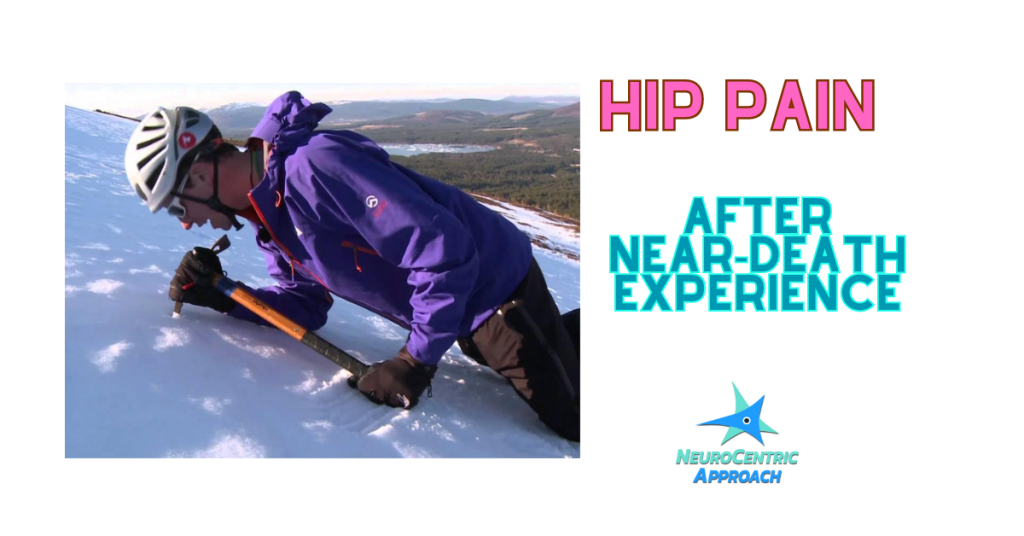
NeuroCentric Approach-Near Death Experience Leads to Chronic Hip Pain
Transcripts from the video above are below...
Phillip Snell
That is next weekend here in Portland. That's the 20th and 21st of April.
And that,
that course is gonna be at Evolution Healthcare and Fitness in Portland.
And you can register for that at https://neurocentricapproach.com/events.
There should be a link for those of you over here on Facebook on the bottom of the, the live feed here.
If everything worked the way that it's supposed to, every week we get together over here with the members of the online academy on Zoom.
And cool part is they can ask me questions and we can interact. And the, the point of this is to try to see if we can take the material that they're learning in the online academy, which is 35 hours of online continuing education, and also take the material that they've learned in any in-person courses for us, and then help to expound on that and learn how to integrate it clinically by having regular tutorials and skull sessions here in this kind of environment. So if you are interested in joining us there, you can go to neuro centric approach.com and find links to the online academy and also links to the events.
These weekly meetings that we're doing here are also recorded. If you go to neuro centric approach.com/blog to the blog, there's a tab for it there.
All of these prior meetings that we've done are there. So if you're interested in what the hell this is all about and why it's something that I think personally you should pay attention to, then go over there and spend a few moments and see what our, our process is about.
We've got people coming on here. Dr. Mark Keller's gonna join us in a wee bit. He's going to share one of his case studies this week.
I wanted to briefly talk about an event I went to last night. It was, I went to have dinner with some good friends, coworkers, and my wife, who many of you know, is a psychologist working in the emergency department at Kaiser.
And so this was a room of healthcare professionals, MSWs, PhDs and md.
And it was interesting, we had interesting conversation about
the resiliency that people have or don't have in their kind of world. And one of the, the, the psychiatrist was talking about
was talking about ACT A CT, which is accepted and commitment therapy.
And I was interested in this. I've heard of this before, again, being around my wife for this number of years, married 30 years now. And I've, she's a cognitive behavioral therapist, former tenured professor and co-author from of one of the most frequently cited papers in depression research.
And this a CT is the offshoot of radical behaviorism from Stephen Hayes at UNLV. But it was interesting as this psychiatrist, you know, told me about this particular methodology, the thing that struck me most behaviorism began with BF Skinner.
Then you got radical behaviorism from Steven Hayes and now you got a CT from other people. And interestingly, the person that started a CT is somebody that my wife worked closely with in her grad work for one of her, her papers there.
So it's kind of, it's always fascinating to me to see the lineage of thought in various fields, certainly my own, and to go back and try to find the origins of ideas and I for maybe ignorance or hubris. But I don't think that I'm any different than you or any different than any other thinking person who's developed ideas and theories over time.
And sometimes you come up with something novel perhaps. But in this particular case, a CT is a repackaging of older concepts.
And I say that with a little chuckle, almost derisively.
But that is essentially what we're doing here.
I did not invent MDT or NDS or DNS or any other named acronym. But what we're trying to do is put it together in a delivery system that allows a person to integrate whatever tools they have in concert with the best available current evidence on neurological involvement in chronic pain. That neurological involvement can be to down based on our pain neuroscience education material.
It can be bottom up all the way down at cellular level to systemic interventions or systemic issues that sensitize neurology, read hard living, oxidative stress, et cetera. And it can be from irritation of peripheral neurology. And that's something that you and I might have called once upon a time, a myofascial trigger point. And that is best evidence currently would suggest a, an interface problem between small cutaneous neurology typically and the compartment that it goes through. And then you can also have interface dysfunctions as well with peripheral mixed peripheral neurology and such. So there's a little bit of, hmm, seeing the way things go in in other professions and in my own and seeing the parallels there.
I think we're onto something with this neuro centric approach. And as time goes on, I think we'll we'll see lots of others jumping on to this or other bandwagons 'cause others will certainly come in and start working this particular model as well.
But there, there needs to be a greater appreciation for how threat is pushing things towards that. And before we move to Mark's case presentation this morning, I want to toss a challenge into my neuro centric approach online academy cohort. Here I'm gonna see if I can get over to a post that came up on evidence-based chiropractic network this morning.
Here it is posted by an anonymous member. So guys, I'm gonna give you a shot you members on the academy to weigh in here and tell me what you think is going on here.
The poster says I saw the weirdest disc in my office the other day. Male patient 32 with a history of disc herniation back in October of 2023.
It has gotten better, but the only thing is when he lies belly down, it will stiffen up pretty bad when he can't move much for 20 minutes on evaluation. Could not provoke the pain with slumps, kemps, or any directional testing. However, upon treating him face down for 10 minutes after his acupuncture and adjustment, he got up super stiff, like as if he was acute and he could hardly bend.
He also complains of peeing in the middle of the night ever since. No matter how little water he drinks at night, the doctor checked him through and said nothing to worry about. Any thoughts here? Tips? I've never seen a disc that is asymptomatic 90% of the time unless face down X-rays conclude minimal. DJD at L five S one yeoman's was bilaterally reproduced or yeoman's test bilaterally reproduced pain on today's visit.
All right, kids have at it. What's your first thought? Shout it out.
Marc Heller
I once the test was positive gelman's, I'm not familiar with that or I don't recognize it with that name.
Phillip Snell
Yeoman.
The Yeoman's Test. Typically to determine sacro iliac involvement, but it is a pro, you and I might use it mark more commonly to see if there's some tension on the front side of the hip, possibly tightness in the SOAs. So prone patient, a doctor is facing, facing towards the head and places a stabilizing hand on the buttock or SI joint. And the active hand reaches underneath to the anterior part of the patient's knee with the knee flexed at 90 degrees and provides extension in the hip and extension putatively in the SI joint.
And so to my mind, you're getting extension in the hip, extension in the lumbar spine and extension in the sacro iliac joint as well go.
All right. Tyler's first one at the Tyler, Dr. Tyler Johnson. It's the first one in on our game this morning and he says instability.
I like it. What do you got to add to that Mark? Alex?
I, you know, where I would probably go is I'd be thinking, yeah, the disc is improving, but perhaps we have a zone of hyperintensity that when there are in prone position, it's irritating it and whatever nerve root it's passing is getting ticked off and maybe even a little adhesive as that disc juice does its thing.
Yep. There's a possibility as well. Now if we were to take, what you said is describing a different structure and what Tyler said, which described a process and we tried to put all of those things together under one word name, what would we call that in the NCA model? What are you looking for in that patient that comes to you, broadly speaking, Tyler, for the win again, correct,
Correct, Correct. So that was what I back or posted for our fellow here.
And let me read what I wrote. I said find the threat. Threat can be top down, bottom up, or both. If primary threat is peripheral, the most common threats and lower lumbar presentations are threats to spinal cord and nerve roots.
Most common threats to those structures. A mechanical encroachment on nerve root from a disc osteophyte, facet ligament and flavin or chemical irritation of the nerve root from local inflammation of some injured structure or instability of the motion segment. So that second one there is the one that you identified, Alex, and the third is the one that Tyler was ripping on.
The first two are easier to rule out with MDT and NDS. I said, yours sounds like an instability pattern for clinical evaluation. The two best clinical prediction rules are hides 2005 and la Reer 2022. If findings suggest instability, those papers show best evidence stabilization strategies. If effects are not as hoped, get dynamic x-ray and if indicated, refer for surgical consult regarding lumbar fusion.
And there we have it.
There you have it. I like it.
So yeah, all all testable.
Marc Heller
So the, the, the simple thought, the simple thought I have is this person gets their symptoms when they're prone and a positive yeomen so they're not tolerating extension very well, could put a little pillow under his belly and took him out of extension into a, a more neutral prune position. You know, just a simple strategy to try to change something in there.
Phillip Snell
Yeah. The way that I would, I, I do this with all of my patients when I place them prone for any length of time, if they're gonna be passively there, if I'm gonna put hot packs, cold packs, stem, microcurrent, anything of that sort on them for a period of time in that position, you know, one of my colleagues that I used to work with Bruce Chaser, he got me into a habit of using SOT blocks and just putting them bilateral under the A SIS and then anybody that's got a little bit of mileage on their low back, that always feels good. It gaps the facets nicely and takes 'em out of that hyperextension often that they can find themselves in, especially if they have different body morphology.
You get a person that's got really big legs from muscular development or from a bit of extra fat, then they might wind up in that hyperextension position as well. So yeah, that's something to do. All right, mark your mic's on.
Why don't you take us through your, your case that you were talking about.
Marc Heller
Okay. This is a 72-year-old male, a retired physician, a little bit overweight, but very physically active.
And he came in with 10 years of right buttock, lateral buttock pain
when questioned. It has an interesting history of a lot of the Mang syndrome. I see, I see Mark
Phillip Snell
Breaking up a lot Where they had a preview.
I'm, you know, I'm, I'm, I'm not sure,
We'll, I'm not sure we'll be able to manage the, the fee 'cause it's, it's really slowing down for periods.
Maybe if you stopped and check out the day and checked and chat with us while we're chatting. So we've got a consistent feed.
So I heard of retired physician with low back pain and right buttock pain with an interesting history
Marc Heller
Only one bar. Yeah. Let me, let me now I've got a little better
Phillip Snell
Turn your video, turn your video off then brother. That'll Okay. That'll reduce your ba your bandwidth.
Marc Heller
Okay, here's the story there. Go seven 72-year-old male,
this 10 years of pain getting gradually worse the last couple years.
The one thing, I think this was something like five or six years ago, he was about to take a trip to Japan.
He saw an injection type doctor who did a steroid and pain, you know, injection. And that gave him a period of relief. But the problem recurred is my audio coming through now
Phillip Snell
Better? Not perfect, but better. I think we can follow up. Okay.
Marc Heller
So then, as I said, he didn't have the pattern of having a history of a herniated disc.
Instead he had a old injury and the injury occurred in the early eighties over 40 years ago.
He was hiking in the snow across a ridge.
He had his ice ax in his backpack but didn't get it out.
And all of a sudden he founds himself sliding down the mountain and he sees a big rock down below him and just below that a cliff, which he was close to falling off of as he kept going. So he, he aims himself at the rock and stops his momentum by banging his right lateral hip into the rock and then grabbing the rock. So he saved his life probably by doing that and ends up with a huge hematoma and some local pain for a while.
And then had some off and on pain for a while. And then 10 years ago, much more chronic on exam. One of the interesting parts was he was absolutely incapable of in a sideline position, lifting his leg laterally. So his gluteus medias was severely inhibited, whatever we wanna call that. And anyway, so we, we found his tender points, which were mostly right over ileo hypogastric nerve, right over just below the iliac crest. He had some secondary stuff up a little higher in his spine and he, he was, he when, when the DTM worked for him, he was one of those great patients who actually did it several times a day.
Not always the case obviously. So anyway, and, and he did real well. One of the things I tried on him that in this case didn't do much is when I find inhibition of gluteus medias or gluteus maximus, this is an old AK thing, I go to the upper cervical and palpate that and see if a mobilization there changes immediate gluteal inhibition slash strength. And that didn't do squat for him, but the DTM did a bunch and then on our second visit we got in deeper and whether we call it CFM or call it Graston or whatever we call it, we did some deeper work in the area and maybe we were working on superior or inferior lute nerve.
I don't know that I'm as confident in my palpation of those structures as I am the al nerves. But anyway, you know, by the third visit he was out of pain for the first time in 10 years and had good function of his medias. So it, it was the most interesting part was listening to the history of a trauma that probably caused this, you know, so
Phillip Snell
Well in this case, what was the primary threat? Clearly it was a cliff.
The, I'm, I'm happy that it had a happy ending.
The, yeah, the, the first thought that came to mind if I, as I was trying to consider the vector of the original injury, I got hit by a car on the hip like that once upon a time on my bicycle with the, the kind of hematoma that you described and pretty much just on the posterior lateral aspect of the greater trocanter and that particular area you've got, if we think about the things that reside there, you've got your, your collected gluteal tendons, you mentioned the gluteus medias, and of course the, the, if, if a person took a really hard shot onto that spot, first thing that I'm wondering if you can't use the muscle at all is, is is the muscle there?
I've seen that as well in some patients that an impact on the bony attachment causes an avulsion of some part of the muscle. So just seeing whether or not there is actual physical muscle, there is one possibility certainly if he gained, he, he, he had, he gained the ability go ahead to ab to abduct the, the hip afterwards. And there clearly is muscle bulk there in terms of injury to the, the innervation to that muscle.
You mentioned the in inferior and superior gluteal nerves, the superior gluteal nerve would be the one of interest for the gluteus medias and for the TFL if the impact was primarily there and the superior would be the primarily affiliated with the gluteus maximus. And the difference there too, from a sensory component is there is no sensory component in the inferior gluteal nerve. There is an articular sensory component in the superior gluteal nerve. It provides some, some articular sensory to the, the bursa and to the posterior aspect of the femoral acetabular joint. So, and in terms of the palpation, you mentioned Mark, in terms of palpating those two structures, I appreciate that difficulty.
You're working through a hell of a lot more tissue, right? You're Yeah, it's a big guy, right? Yeah. And those nerves are buried deep within the tissue. But what you are, what you're looking for to help discriminate between the colonial nerves and the gluteal nerves is if patient is erect, the lumal nerves are going to be oriented roughly north south and the, the gluteal nerves are gonna be oriented roughly east, west and your, your landmark that you'll look for there is the piriformis and you can map out the piriformis going from the greater trocanter of course to the lateral of the border of the sacrum, find the piriformis, and then right over the top of the piriformis is where those nerves come up and can be, the origin of them can be sort of found.
And that'll help keep you a little, it it'll be medial to where the sciatic nerve will be too. And that will help to discriminate from all of those. So sciatic nerve a bit more lateral, the, the gluteal nerves a bit more medially and running east west rather than north south.
Marc Heller
Okay. That I've heard that at the class and it's yeah, to get
Phillip Snell
So, And, and what
Do you think's going on? What do you think's going on, mark? What do you, why do you think he
Marc Heller
Well, I just think, I just think he, he, he damaged that that injury impacted the, that ileal hypogastric nerve and he couldn't get out of the cycle and DTM was the magic for this one. You know, just free freeing up that nerve seemed to give him relief. And then he started to develop some function in those muscles,
Phillip Snell
Ileo hypogastric which, which part of the ilio hypogastric?
Marc Heller
The, the posterior, posterior posterior fibers or lateral fibers of the ilio hypogastric nerve found over the superior gluteus medias just below the iliac crest.
Phillip Snell
Okay. That's, That's been a spot that I've been aware of for many years and find significant. I, it it's, you know, it's a clonal it's part of the clonal nerve complex and my understanding of it. So anyway,
The, That was,
I could see pain from that nerve being part of the inhibition. When he tried to,
to abduct the leg, did he feel pain or was it just weak?
Marc Heller
Oh, good question. That I am not sure I asked it that way. It was obvi, it was clearly weak and I think it caused some pain as well.
Phillip Snell
So yeah, I could see a pain inhibition in that the lateral branch of the ileal hypogastric nerve at that point is pure sensory.
And and the further or or more proximal where you described in the abdominal wall, it is mixed. It has motor to the, the oblique muscles there.
Marc Heller
And so, but the thing thing about it is that, you know, if you have persistent pain, whether a motor nerve is being impacted or not, the, the pain will create inhibition. You know, it's like it hurts, I can't do this anymore.
Phillip Snell
Yeah. The way, At least that's my understanding of it.
Yeah. That's the way, the way I described that to patients is that pain then is like a, a huge rock in the middle of a stream, you know, the, the, the stream still flows, but it flows in a different way around that impediment. And sometimes if the rock's big enough, it can dam up the river or you know, in this particular case dam up the movement pattern. And it could be as well if, if the upper portion of the ileal hypogastric nerve, the motor portion of it was affected in that impact, think about the action of abducting the hip in order to abduct the hip.
Everything in that lateral compartment needs to be able to brace and stabilize. And if he's not able to get, you know, good motor control of that lateral compartment of the abdominal region, then it's gonna be a little bit difficult to gain that moment, moment arm to get the abduction in the hip joint itself. So yeah, I'd say check, yeah, work, work in that abdominal wall. Check that out. The seated DNS eval of the four quadrants for the interabdominal pressurization, we've talked about that on here before. I know you've not done the, the DNS course, but the, you got four points there, two in the back, two in the front.
Marc Heller
You're talking about a bracing, a bracing strategy,
Phillip Snell
The breathing embracing strategy and see how competent they are. So in a seated position, you sit behind them and eval those four points and direct them to diaphragmatically breathe and see if that rests with just normal tidal respiration. They're able to expand in the abdominal wall on all four of those points. Well, and if they are then have them practice bracing, closing their glottis and bracing and seeing if you get equal pressurization on all four of those points. If they have motor deficit to that quadrant where he was, where he had that impact, that will be a way to pull that out with then DNS would have them in that position while you're evaluating just lifting a leg, flexing the hip just a few inches so that the foot is non-weightbearing on the floor so that you can see how well they adapt to that.
And if their corso was moving around quite a bit, then that would suggest that they're not stabilizing appropriately. And that would be a, is
Marc Heller
That a, is that in a sitting position or? Yeah, yeah. Okay.
Phillip Snell
That, that would be an assessment for that and that would give you a window functionally to, to, you know, work for a few more visits with them to see if you could improve on that.
Marc Heller
So one of the things I've done forever is palpated muscle bulk and the quad lumbar area is a very difficult test to do a manual muscle test on. So if, when but when they brace can they activate that? And if they can't, I'll have him do a side plank if their shoulders are intact. I have so many older patients who can't do side planks or a suitcase carry.
I I use suitcase carry a lot. And anyway, so I have him doing suitcase carry and I'm, he's doing, he's doing sideline leg lift now and I think I started with some gluteus max oriented one leg bridges also. So
Phillip Snell
Yeah. Anyway. Very good, very good strategy.
Marc Heller
It's a, it's a, it's a very fun case. Yeah.
Phillip Snell
Yeah. That I think that's all I have to offer Robert.
Yeah, mark, give, hopefully you're gonna see your doc again and keep us abreast of that. It'll be fun to see how that one progresses over time and
Marc Heller
Yeah, sure. That it, it's like this guy is like not quite done, but he's a happy camper and more or less out of pain and after three visits, you know, so it's great. The quick ones are a, a quick one that has 10 years of pain is a wonderful thing, you know? Yeah.
Phillip Snell
So those are, you know, regardless of what happens there, that's another one of those ACMs, right? Another chiropractic miracle,
Marc Heller
Right? Yeah, yeah, yeah,
Phillip Snell
Yeah. We, we love those. Yeah. So let's see. My, does anyone have any comments, questions for Mark there?
And Mark, thank you for, for weighing in here and bringing your case on. It's, I would love it if you guys would do that as well.
It, you know, from a, from my vantage point, it helps me to see where we might be falling, where we might be excelling and where we might be falling short in delivering this particular material. So it helps me to get a better understanding of, of where you guys are in your process here.
If we have time at the end after your case. I have one that I just had yesterday that was particularly interesting. So if, if there's time today or maybe next week or not next week. 'cause we're gonna be busy.
Yes. We'll
We're gonna be busy. Yes. But if, if there's time
Let's prioritize you here. I get enough floor time here Alex.
Alright. So, And I, I had a few extra drinks last night with my friends so I have to, I have to, to let
Alexe Bellingham
Admit to have enjoying some wine myself last night with the girls. So it was, I may come across a little foggy here. Okay, so a 43-year-old active duty service member female has had two children. One C-section, she's pre-diabetic and low vitamin D.
She has, she presents with 15 years of low back pain and a more recent five year history of right anterior thigh pain that has been uncomfortable to the point of tears. And that was the reason why she was in my office. She was a non-program patient. We have people who usually go through a program when they see me, but this person had seen one of the pain anesthetists earlier in the week and had had a previous sacroiliac joint injection on the right side in hopes of addressing a region noted on MRI that had a T two hyperintensity at the anterior inferior aspect of the siliac joint. Hmm. The injection increased pain of chief complaint of the thigh and on the follow-up patient was tearful, frustrated and just wanted something to help her get fixed.
So a lot of frustration, probably some other things going on in her life. Of course she presented to my office yesterday three days after her follow-up with the doc and she presents with a pretty significant anteriorly tip pelvis. She is likely about 20 pounds of her at this point and not as serious about her pre-diabetes is probably important because her A1C is now 6.1.
She, let's see pain region.
The most concern of course is the anterior thigh pain and so on assessment we did ranges of motion. She has no problem with hip flexion, active or passive, which was really rather surprising to me there a passive range of motion is limited on the right side to about 90 degrees. However, I was a little concerned that it might've been the tightness of her uniform 'cause she was wearing her uniform on presentation. But we were able to assess that it improved after some treatment. So I'll get to that here in a second. So I think that was more of that threat that you were talking about. What when I saw the restriction passively actively when she did it, she did not raise it to 90 degrees in standing, but her balance was good.
I didn't see many concerns with an SI joint type of effect.
So I chased down more the, the cesarean section, the anterior thigh pain. We discussed neuralgia paraesthetica and went after the anterior femoral cutaneous nerve there where it's crossing through that lower abdominal region and after soft tissue work through there. Then also working on posterior glide of the hip because she'd been protecting it so long, there was just no posterior glide of the hip. She was able to appreciate at least 20 degrees more motion in hip flexion. We also adjusted the SI joint 'cause I think it was ticked off from the, the injection. So we took care of that. And she also had left sided interscapular pain, which we talked about why right hip left interscapular might be connected.
So she got buy-in on that too. Overall, very pleased. We also discussed posterior pelvic tilt and how to open up that anterior region of the hip to better optimize and create less compression around that anterior femoral cutaneous nerve took before and after pictures. Because when I got her into the position of standing that was best, she said I am I supposed to look like a doofus like this all the time. And I, she looked at the picture and says, oh, oh I see what you mean. Yeah. So great fun there.
But so further down the road, perhaps that was just her first time around. She's gonna come and see me again on Monday, maybe exploring further down anterior femoral cutaneous nerves since it's been so long. You think and look for adhesions there and contributions
Phillip Snell
Yeah. Of the things that you tossed in there. First off, kudos. Really good assessment both structurally and functionally.
I like the, the standing single leg hip flexion kind of assessment that you did there, which gives a huge amount of in information about joint and stabilization strategies.
The, the first things that pop into mind and stuff that I've seen that looks kind of like that scar and weight gain.
Marc Heller
Mm. And the, the combo platter there entirely possible that we've got some changes in that myofascial compartment owing to the, in slight ability owing to the, the, the surgical scar and then the kines or depending on who you talk to, adipokines, the chemokines of the increased adiposity around the midsection there. Right. Will tend to contribute to that and mechanically, especially in people that are wearing uniforms like that, especially if in her uniform she has, you know, something looks like a tool belt, like a tactical operator Right. Or something of that sort.
But we saw a lot of this after, you know, as we came out of our holes in the pandemic where people put on their, their covid Ovid 19 and they, and they hadn't been wearing their, their office clothes for a while and they hadn't yet replaced any clothing that they had grown out of. So when they go back to an office and they sit down, their belts are binding in and providing a mechanical compression right on the front and lateral side of that hip. And I saw a lot of ileal hypogastric nerves, lateral femoral cutaneous and anterior Oh yeah.
From, from that. So those are the ones that, that come to mind for me.
Other ideas about more ex exploration? There?
I I have, I have one idea if I can throw in one thing. Yeah,
Phillip Snell
Sure. Go for it. Mark.
Marc Heller
It it, you know, basically based on my visceral manipulation training and all the other things I've done, there's a, and this is, this goes back to Levitt by the way.
She's got a c-section scar, which is a long, a long scar and it's, it, it's a horizontal scar. And when I palpate scars there's usually a part of the scar that talks to me the, where the, there's a part of the scar that just doesn't feel the same as the rest. And when I touch that, the patient will say, oh yeah, that place.
So I, I would be looking at was this a right sided pain that what you were saying?
Phillip Snell
Yeah, actually it's interesting Mark, I did actually look at that. It was the distal aspect of the scar where I felt the greatest adhesions. And what's interesting about her scar is it wasn't just a c-section, they did a tummy tuck with her last baby also. So she has both the lymph drainage changes and also the, the cesarean section scar that's typical in that area. And we know that the right-handed surgeons usually make more scar tissue on that right side.
So I always go looking there 'cause I get so many of those patients
And right there I i I had no idea of that last thing you said. That's amazing. Thank
You. I I was I've been able to figure that out. 'cause I've asked some of my patients that have had more of the scarring on the left side. I said, was your surgeon left-handed? And they said yes. Yes they were.
You know, the the other thing too on that lateral border of the scar, whichever side it is, is where they tie that knot off. Right. Right. And that knot is where we'll commonly have the, the greatest amount of palpable change there. I love your description there, mark as well. The, the part of the, the scar that talks to you. Yeah. And you know, getting into your hands to that point, just noticing difference. And then if it correlates with the patient of ouch that is, you know, something that feels important to me, then that might be something to, you know, quote unquote lean into.
Yeah. From an assessment standpoint, if you can then associate it with something like an index movement, that will be a delight as well. So the thing that comes to mind perhaps in standing or supine, if the patient is having difficulty with hip flexion in supine, can they passively flex the hip with a or or actively flex the hip with a straight leg longer motion, harder to do, does that cause pain? And if it does, then you've got an index test you can play with and then you go into your scar and you mechanically change tug and have 'em repeat it and then if it changes it, then that hones you in on an area of interest to, to spend time.
Alexe Bellingham
Yeah, I I like that her, her main motion complaint was swing through phase of gates. So going from push, push off to swing through. And I was thinking, so I think I like what you're saying, I I might start her in almost an obs position and then have her lift from there to find that index movement. 'cause she seemed to do okay from neutral on hip flexion. It was just more of that more posterior to neutral.
Phillip Snell
All right. And the other thing that comes to mind in terms of honing in, now that you've, you've globally kind of come into the area of interest and you've assessed it and you're like, I've got something here. And you've, you've taken it at arm's length and now as you go in and hone your, your approach, the, all of the neurology that you're going to be playing with there and, and the description of that pain is all sensory cutaneous.
So get her, get her down to skin and then do you know either a wartenberg pen wheel or a scratch test? Yeah. And a sensory exam there for soft touch locally and map it out and, you know, I'll take a, an ink pen, ask permission to make a mark and then just, you know, say, all right, when you come up from posterior to anterior and say, okay, tell me when it changes. Not when you can't feel it or you Right. Whatever. When it changes and when it changes you just make a little mark and then you go a little lower, you make a little mark and then lo and behold you've got a nice little dermatomal map of the structure that you're playing with.
And it helps then conceptualize, okay, if we're working anterior femoral cutaneous, I'm gonna be a little bit more differently positioned and considering the femoral nerve a bit more right? As from a mechanical perspective where if I'm working lateral femoral cutaneous, I'm gonna have a predictable number of interface points that we discussed in the course up further in the iliacus and then working around into the, the, the quadrat lumborum. So your, your points would be different there based on what you found in your cutaneous exam for the, the dermatome of involvement. So just a thought. Thank you. Yeah, good stuff there guys.
And I've got one, my case was somewhat similar to that and I'll, I'll deliver it as yet another interesting combo platter. We've talked a lot about combo platters around the shoulder, right?
How we can have, you know, from the NCA perspective, we've got four primary nerves of interest on shoulder complaints when the patient presents with shoulder pain with a movement.
And those would be the, the posterior aspect of the shoulder, the axillary nerve and the radial nerve and the dorsal scapular nerve on the medial border of the scapula and the supraclavicular nerve draping over the clavicle and AC joint and the superior aspect of the shoulder that mind you the, that's cutaneous innervation over the AC joint. The AC joint itself gets innervation otherwise primarily from the suprascapular nerve. But as we've mentioned, the, the model suggests that irritation of that neurology will alter motor behavior. So the motor behavior will change in order to offload the neurology and that altered motor behavior can then in a tertiary way alter arthrokinematics.
And then you can wind up with joint pain. And in the shoulder what we'll typically see is an elevation of the shoulder, usually hypertonicity and the upper trapezius and a forward positioning of it, a tightness of the, the pectoral muscles across the front. So that in turn can give us something that looks like a cervical brachialgia.
It can also alter, it physically narrows the subacromial space and changes the mechanical drive there. So depending on whether you are old school working a model of subacromial impingement, which is a little bit older, outdated and doesn't, has suffered some under the, the, the recent evidence to suggest that because the typical rotator cuff problem is on the underside of the tendon. The more modern definition here would be subacromial pain syndrome. And the thinking is that it is the altered position of the shoulder that causes increased pressure compression of the tendon on the underside where it attaches to the humerus.
But in the hip, I had a patient presented a 62-year-old who had two years of ongoing pain in the posterior and anterior left hip. After for the celebration of his 50th birthday, he went down to Mexico and ran the Caballero Blanco Ultra Marathon.
So that's a 50 kilometer race for the shortest distance. And after that, and and of note it was a 15 hour bus ride to get there and a 15 hour bus ride to get back. So in the intervening time he's put on 40 extra pounds.
He's in terrible shape. He was smoking at the time as much as a pack a day when he took off and ran that thing.
He's been smoking a pack a day since he drinks too much.
So we've got things in his personal life that are, are pushing those and that's causing, you know, a another issue that we've gotta deal with of systemic irritation of that area. We've got local chemical and mechanical irritation 'cause he's got a pendulum abdomen.
He hasn't changed his clothes either since the pandemic.
So the same kind of situation I was describing, Alex with your patient Wow. Present for him on the front side.
So on the exam, his posterior hip pain, the, the symptoms were his sciatic nerve was hot on tension, on compression, hi. He had very little extension, so did the directional preference examination. And lo and behold, the posterior hip pain did actually improve when we did repetitive end range loading for extension.
And yet he had some pain on the front side of the leg as well with that. So the, on his motor examination, he was deficient on the S one myotome on the affected side, and he was deficient on the L four myotome on the affected side. So now I'm thinking upstream motor issues at two different nerve routes of origin.
So a McKenzie, you know, I, I always like to lean to McKenzie first, not because it's more effective, just because the compliance is easier than NDS kind of stuff and putting them in a static opener.
So after doing a little bit of manual therapy across the front of the hip at the anterior femoral cutaneous and lateral femoral cutaneous interface points, he didn't have any pain on in the front of the hip on the, the prone press up. So I went ahead and leaned into that. But his index was standing, he would lean to his unaffected side, take all weight bearing off of his affected leg, and he would with a straight leg, just externally rotate his hip and that would cause the pain.
So hip exam was actually positive, positive for FAI test of the fader. And the Faber tests were both positive and hip scouring was positive.
His single leg heel drop negative and the test negative. But it suggested to me that that tightness in from the threat in the SOAs was creating a bit of a malposition issue for the femoral acetabular joint.
So using the things that we worked on in the, you remember in the, the second day of notes for the lower quarter course where we talked about the, the orientation of the capsular fibers in the hip and our theory and, and the innervation patterns of the various nerves in the hip joint itself.
I went in and did mobilizations on the hip to see if I could get rid of the remaining pain with his index movement, which improved by about 50% just after doing the prone press-ups and the DTM over the, the cutaneous elements.
After going in and doing the mos for the hip to address the sciatic nerve component to the femoral acetabular joint and the femoral nerve component to the femoral acetabular joint.
He stood up and it was that lovely moment as you see where he goes in, sets up to do the index test and expects the pain to be there and does it a handful of times and there's no pain there and the mouth drops, he look, you know, looks over at you and he is like, it's it's not there. It's not there. And it's like, yeah, it's, yeah. So let's lather, rinse and repeat, but we'll have, we'll have some, some more work to do on that to center that joint to try to drop some weight off. And I had a very, he was a, he was, you can't do this of course to all of your patients, but he was a very, you know, easy to get to know person, you know, and he, he, he had insight that the things that he was doing were, you know, in terms of smoking and drinking, were not healthy, not doing him any favors.
And it was at that point that I had a bit of a, a confrontation with him. A friendly confrontation with him.
And I, you know, I saw the way that he was talking about all of that. No, I know it's not good for me. It's probably gonna kill me. So I'm like, all right, well let's talk about that.
What do you have to live for?
And he oh, said, do you have kids? No, no kids. What brings you joy in life or thought about differently?
You now have, let's imagine a scenario where you have an hour to live and you're laying there and you're confronting what you have and have not done in your life.
What do you wish you had done differently?
What are you going to miss the most by not being here?
And he thought about it for a second and he said, music.
I said, okay, I, I don't want you to go much further than this, but I want you in your mind every time you reach for the drink, which he said, he said, I'm gonna tell you something I've not told anybody else.
He said, everybody else thinks I'm not drinking, but every day my secret thing that I'm getting into is sweet white wine.
And I drink a half a bottle, at least throughout the day of sweet white wine. And he said, I know that sugar is adding to my weight. I said, okay. I want you in your mind right now to think about that sweet white wine. And when you think about it, I want you to take your favorite instrument while you're drinking it. And I want you to ab imagine in your mind that you are absolutely destroying that instrument and your ability to play music with that instrument forever. And I want you to anchor those two images as closely as you can. And every single time that you re when you get that habitual reach for wherever you've got that thing stashed that you're going to get as you reach for it, I want you to see that, that process of destroying music in your life for the rest of your life.
And you're gonna have to live without music for the rest of your life.
So what we're trying to do there is short circuit, behaviorally, those particular points where he's contributing to that. And now what else do I have? I have, I have a situation with an individual who has given me information, privileged information trust.
And when we get that with our patients, that is a clear indication that they are ready to change, they're ready to be compliant with the treatment plan that goes beyond just getting out of pain. Pain. So now I can look at that individual and the things that they're doing beyond that pain that they're feeling and how they might look and feel with 40 fewer pounds and running another marathon or contributing to, in their business to some way to expose others to cool music and to bring the, the situation in his work, in his recording studio and stuff together to be able to, to explore that in greater detail with, with others over time.
That's a beautiful thing. And you know, not stuff we talk about commonly in this kind of work, but sometimes having that come to Jesus meeting with a, with a patient rather than just kind of assuming cynically that this patient doesn't care whether they live or die. All of us care if we live or die. It's just whether you find that point to get a lever under to make that change in that person's life, everybody's got something to live for. So try to find it and see if we can make a little change.
Stay curious people, stay compassionate. Let's use to things we're learning and try to go out there and help some people. Thanks for coming out. We will not be here next week in this environment, but all of you that are on here will be in person here in Portland and hopefully it'll be as beautiful as it looks like it's shaping up to be today. You guys take care. Big hugs to all of you.